Mair Hughes | A Field Guide to the Offa’s Dyke


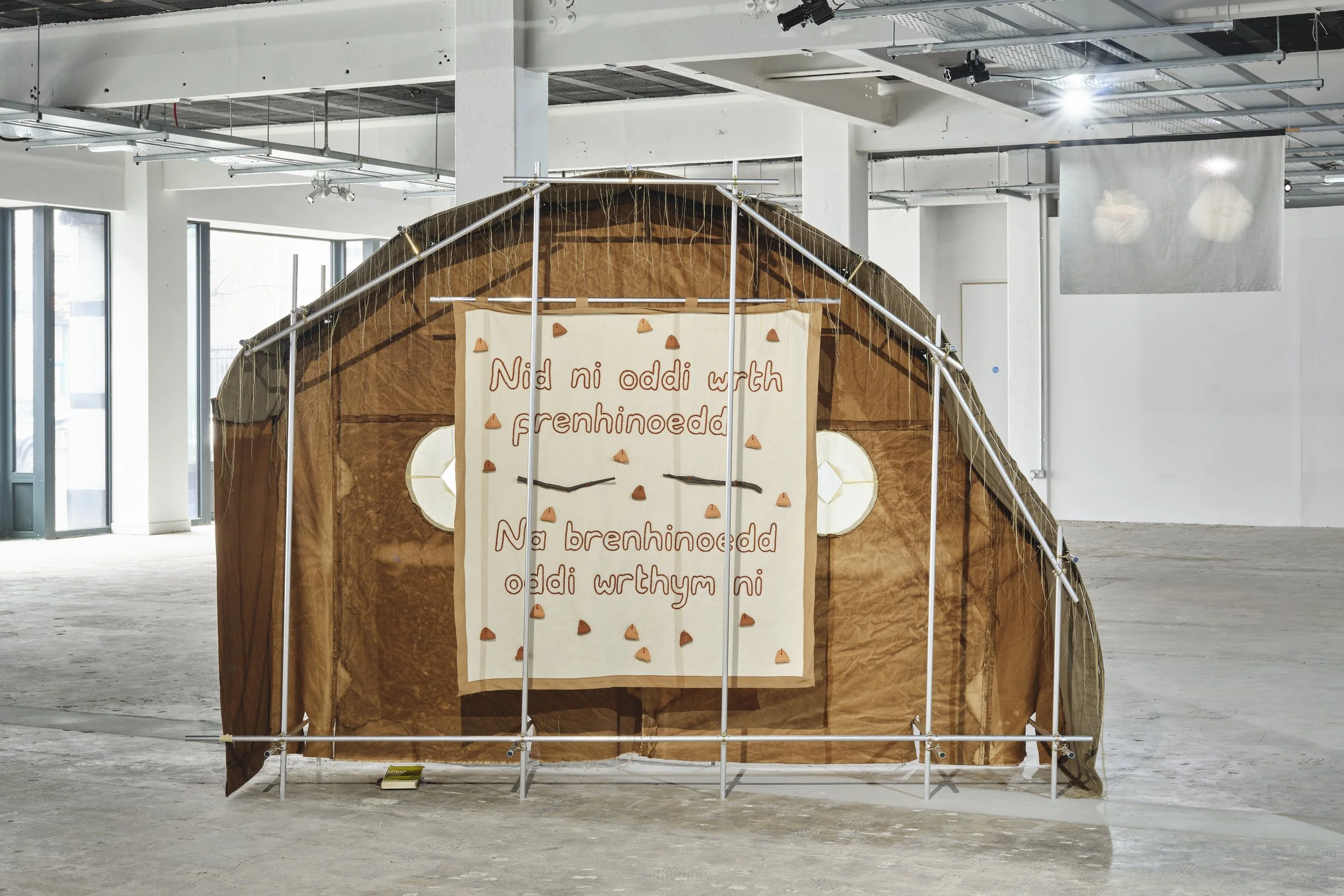
A Field Guide to the Offa’s Dyke/Canllaw Maes i Glawdd Offa, 2025. Dyed canvas, wool fabric, thread, aluminium tubing, metal fixings, cast pewter, and photographic print on textile. Photo: Ros Kavanagh

A Field Guide to the Offa’s Dyke delves into the artist’s experience of growing up in the Welsh borders with dual Welsh-English identity. The installation explores the psychogeography of the dyke in the present time, alongside speculative reimaginings of the borderlands and dual identities as a space of creative potential as well as ambiguity. The installation draws on the form of Offa’s dyke, an ancient border earthwork which marks a distinct physical line across the Welsh borderland landscape. The Dyke was constructed in an uneven shape, with the bank much higher on the Welsh side, to allow long views into the landscape. The wool textile piece reimagines a slogan painted on a farmhouse inhabited by members of the artist’s family. The new version, in Welsh, reads ‘Nid ni oddi wrth frenhinoedd, na brenhinoedd oddi wrthym ni’, which means ‘Not We From Kings, Nor From Us Kings’.

The audio reflects on visits to sites on the dyke, combined with reflections on family and the borderlands.
 

Bint Mbareh | Tidal Memory | Part 1


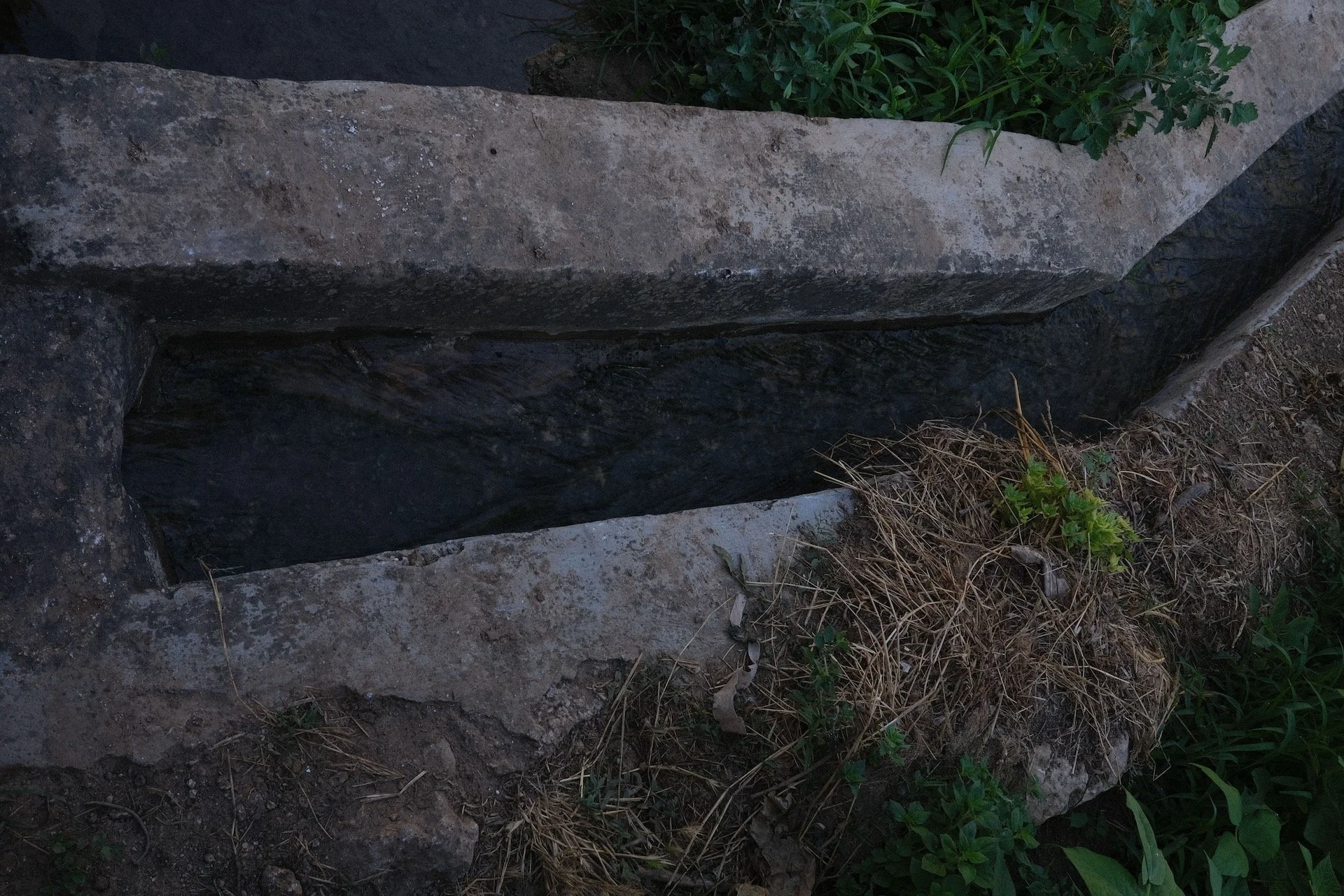
Bint Mbareh is a sound researcher with a focus on water in Palestine. Her interest in the physical parallel between the water wave and the sound wave leads her into questions of border dissolutions (between bodies, between states, between tenses), and into the possibility of being enveloped by the voice, by sounding communally similar to being enveloped by a water body. She challenges Settler colonial epistemology by taking seriously Palestinian ways of knowing, from rain-summoning music to shrine pilgrimage as an instigator to political revolution.

Tidal Memory explores the flows of information passing through time using sampling, sound and research into Bob Quinn's films around historically possible hypotheses. The palimpsestic nature of the sounds implies allowance and encouragement of multiple histories intertwining, but also the politics of power that allow certain historical narratives to triumph while others are suppressed.

Credits include:
Yasamin Ghalehnoie
Haseeba Hisham
Bob Quinn - Atlantean Quartet
London Performance Studios
Qattan Foundation


Bint Mbareh | Tidal Memory | Part 2


Bint Mbareh is a sound researcher with a focus on water in Palestine. Her interest in the physical parallel between the water wave and the sound wave leads her into questions of border dissolutions (between bodies, between states, between tenses), and into the possibility of being enveloped by the voice, by sounding communally similar to being enveloped by a water body. She challenges Settler colonial epistemology by taking seriously Palestinian ways of knowing, from rain-summoning music to shrine pilgrimage as an instigator to political revolution.

Tidal Memory explores the flows of information passing through time using sampling, sound and research into Bob Quinn's films around historically possible hypotheses. The palimpsestic nature of the sounds implies allowance and encouragement of multiple histories intertwining, but also the politics of power that allow certain historical narratives to triumph while others are suppressed.

Tracklist:
Mohammad Imran - The god of all creatures knows what is inside our hearts
Ann Cuilin - Traditional Irish Air
Tai Shori and Hiteniat (Coptic Easter Divine Liturgy 2024) – Choir of the Theological Seminary, conducted by Muallem Ibrahim Ayad
Shada Mustafa (TEN) - from Reworlding: Ramallah Short Science Fiction Stories from Palestine
GnÄw - II - From Kuartz
Assata - An Autobiography
Merope - Aglala
Nadia Saleh - Life-Land from Valley of Words, an anthology of writing from Earl Marshal School, Sheffield
Haykal, Julmud - A'saab
An Otro Gergezeg (Scealamhrain Cheilteacha - M. François Richard) (Pommerit)
Kathryn Yussof - A Billion Black Anthropocenes or None
Suleiman Gamil - Valley of the Kings and Queens
Lady Lykez - Ironheart
Speaker Music - Futurhythmic Bop
Ink - from Voice of the Fish by Lars Horn
Haykal, Julmud, Acamol - Sahbi Yisoon
Dawud Logic - Al-Akhth Bil-Asbab


Emily Joy | Interview


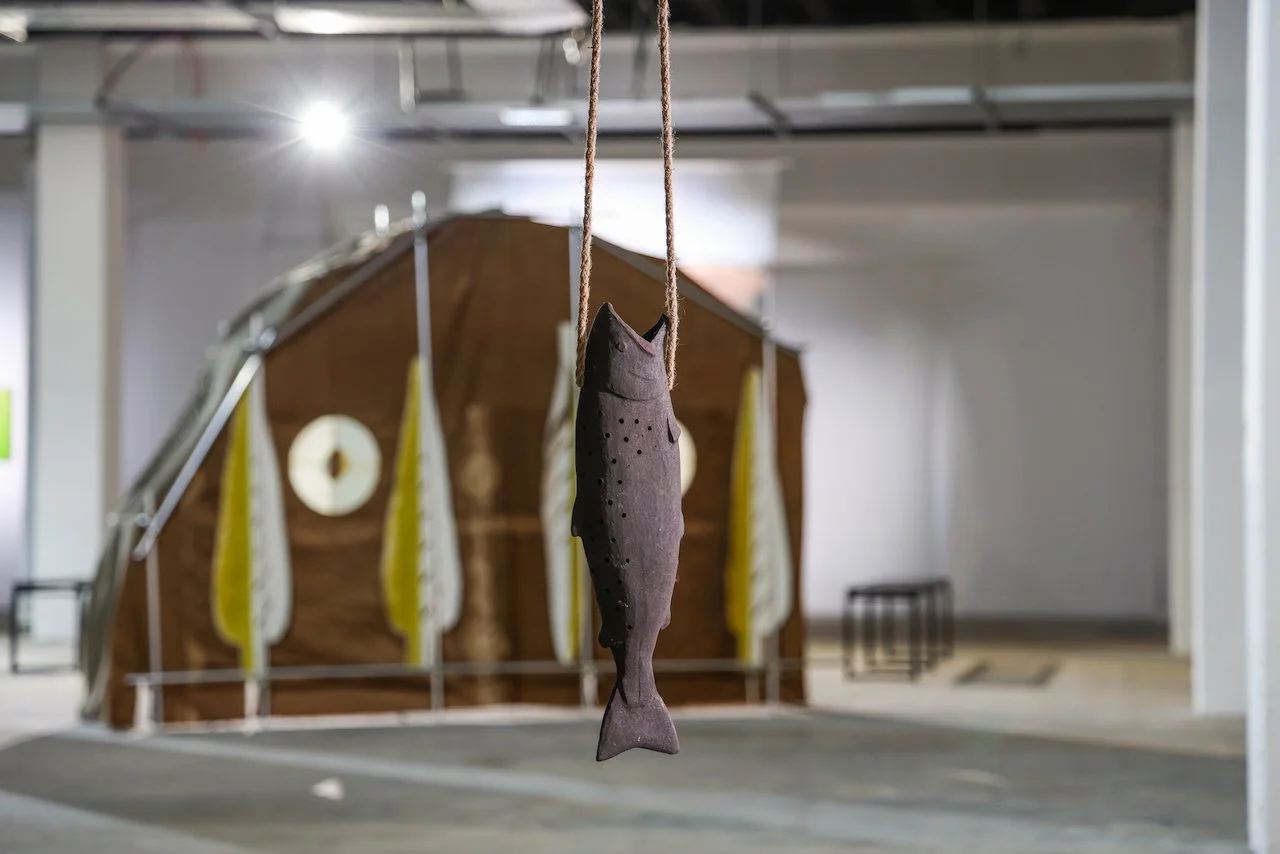
Eog Gwy (Wye salmon), black clay, granulated ferrous oxide, corks, rope. TULCA Gallery. Photo: Mary McGraw

This short conversation between artist Emily Joy and curator Beulah Ezeugo was recorded shortly after Emily’s work finally arrived in Galway. Emily talks about her practice with clay, soil and water, and reflects on the irony that her ceramic salmon sculptures – works about migration, rivers and crossing borders – were themselves stopped at customs as “hazardous” and delayed until the final week of the festival. Together they unpack what this says about borders, Brexit, movement, and who or what is allowed to travel, while also touching on the wider Borderlands / Y Gororau collaboration with Mair Hughes and writer Durre Shahwar, and how the project has reshaped Emily’s relationship to Welsh identity.


A Collection of Ocean Waifs

A Collection of Ocean Waifs was created by Enya Moore, Kate O'Shea, Ron Bradfield Jnr and Padraig Stevens who are based on and between Galway (Ireland), Walyalup (Fremantle) and Gadigal Country (Sydney).

It was created on and between the lands of the Gadigal people of the Eora nation, and the lands of the Whadjuk Noongar people of the Noongar nation. We acknowledge the Traditional Owners of these lands and waterways and extend our respect to their Elders, past and present.

Read more