• Programme
  • News & Press
  • Exhibitions
  • Talks
  • Podcasts
  • Education
  • Shop
Menu

TULCA Festival of Visual Arts

Street Address
City, State, Zip
Phone Number
TULCA Festival of Visual Arts

Your Custom Text Here

TULCA Festival of Visual Arts

  • Programme
  • News & Press
  • Exhibitions
  • Talks
  • Podcasts
  • Education
  • Shop

News

REVIEW: Iarlaith Ni Fheorais | Frieze

November 17, 2021 TULCA Festival of Visual Arts
  Vishal Jugdeo & vqueeram,  Does Your House Have Lions , 2021, film still. Courtesy: the artists and TULCA Festival of Visual Arts

Vishal Jugdeo & vqueeram, Does Your House Have Lions, 2021, film still. Courtesy: the artists and TULCA Festival of Visual Arts

 Adrien Howard & K Patrick,  Silence , 2021, installation view. Courtesy: the artists and TULCA Festival of Visual Arts; photograph: Ros Kavanagh

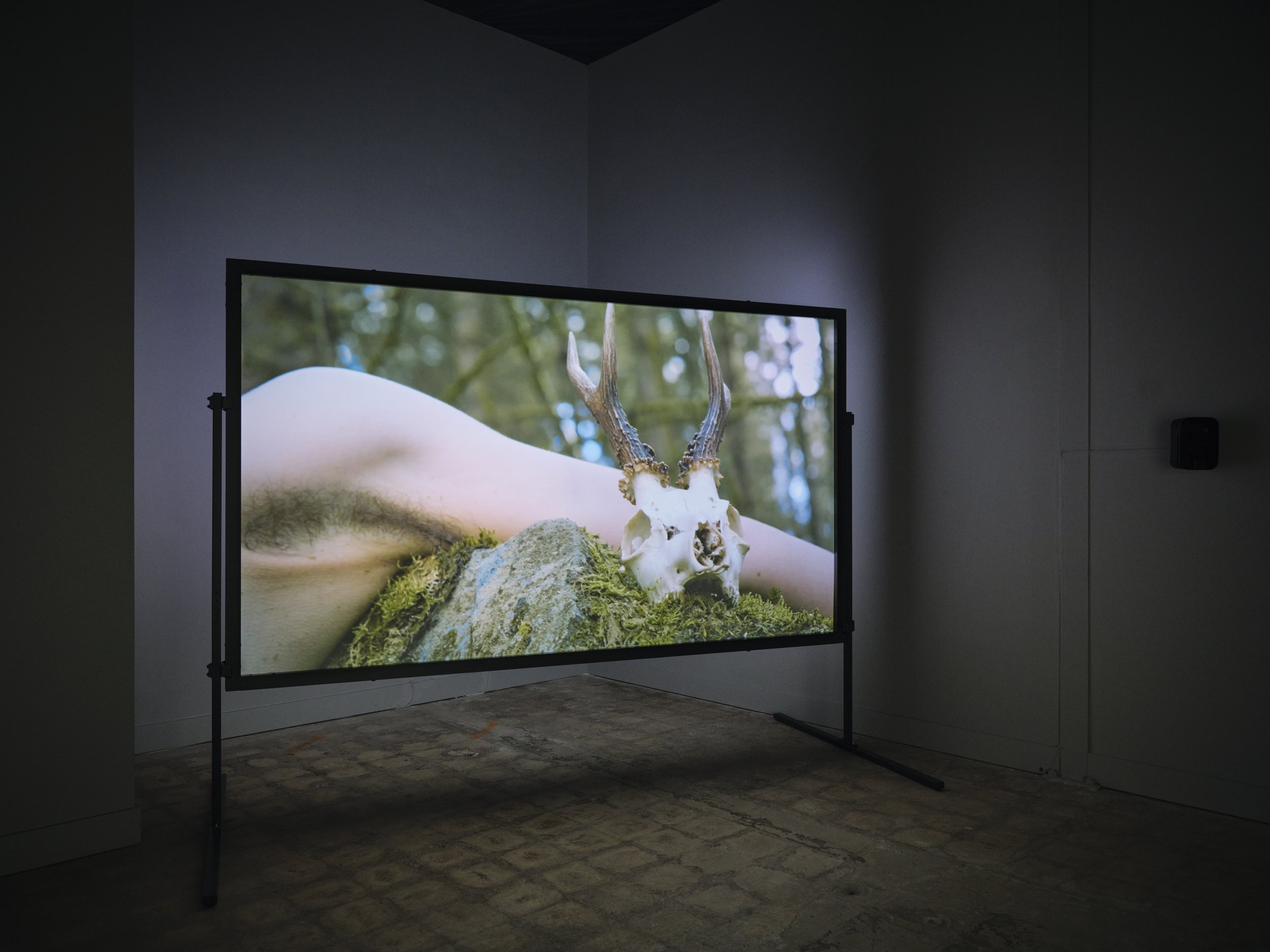
Adrien Howard & K Patrick, Silence, 2021, installation view. Courtesy: the artists and TULCA Festival of Visual Arts; photograph: Ros Kavanagh

 Isobel Neviazsky,  Material is a Friend , 2021, graphite, felt tip, charcoal and pen on paper, installation view. Courtesy: the artists and TULCA Festival of Visual Arts; photograph: Ros Kavanagh

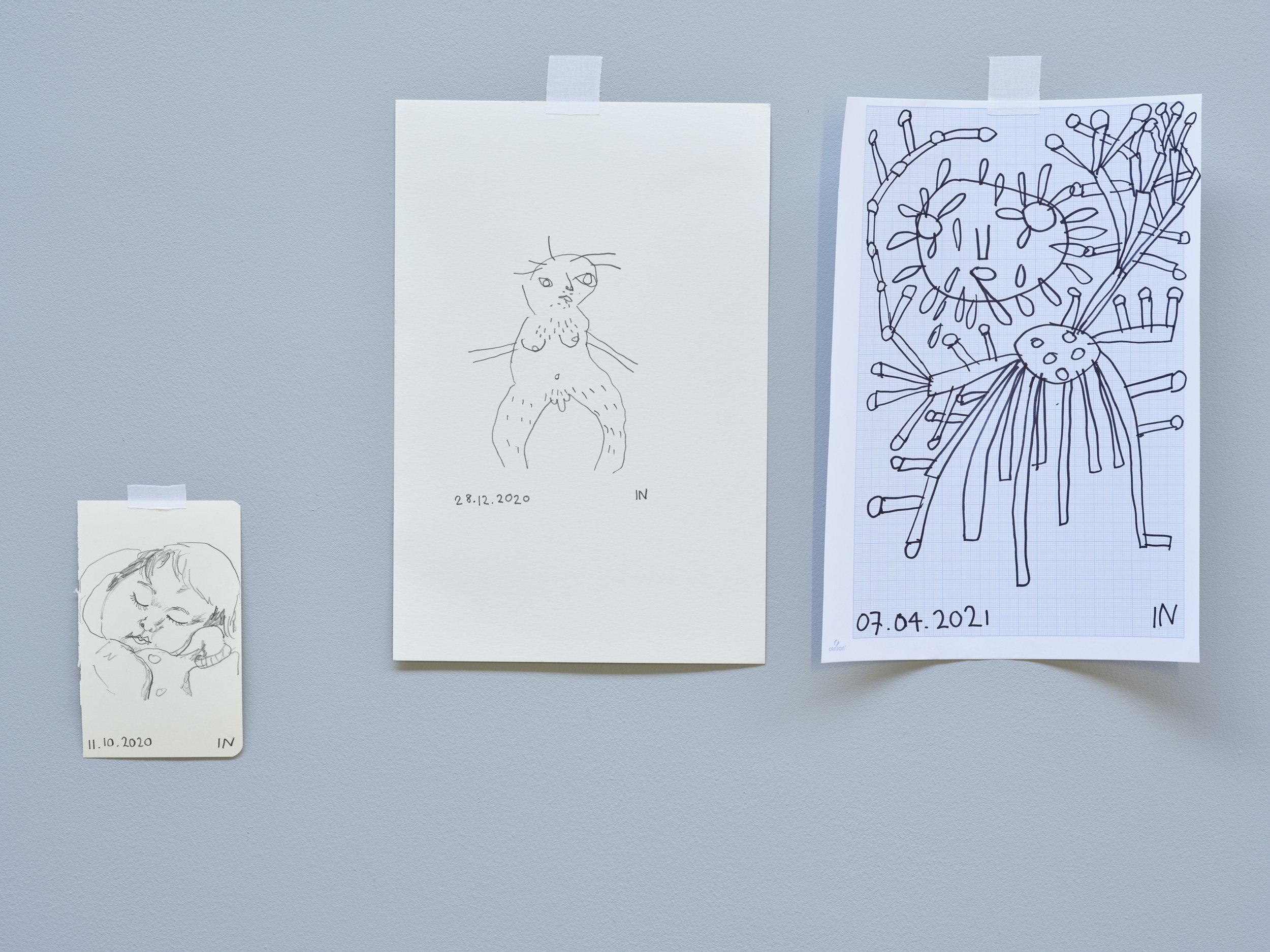
Isobel Neviazsky, Material is a Friend, 2021, graphite, felt tip, charcoal and pen on paper, installation view. Courtesy: the artists and TULCA Festival of Visual Arts; photograph: Ros Kavanagh

 Stanya Kahn,  No Go Backs , 2020, film still. Courtesy: the artist and TULCA Festival of Visual Arts

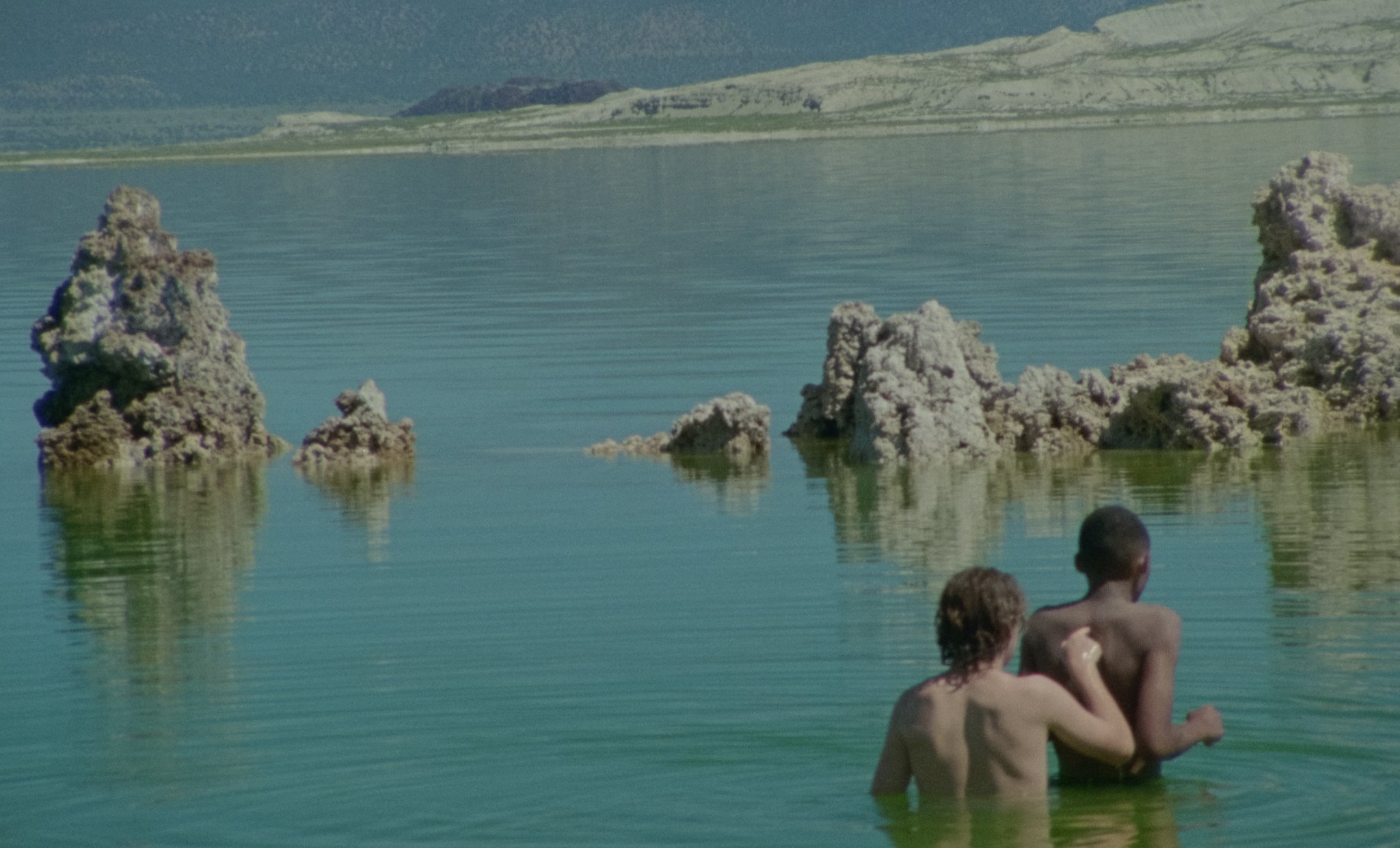
Stanya Kahn, No Go Backs, 2020, film still. Courtesy: the artist and TULCA Festival of Visual Arts

Love, Longing and George Michael at TULCA Festival of Visual Arts


The 19th edition curated by Eoin Dara sees artists pen love letters in Ireland through conversations about cruising, gender and the internet

Returning home to the sodden air of Galway can be bittersweet. It’s a city that lives fondly in my memory as a student town on the edge of Ireland, where oddness was abundant and tolerated with grace. Today, its heart faces the belt of multinationals flanking its periphery. Amid this tension, the annual TULCA Festival of Visual Arts returns this year, curated by Eoin Dara. The title of the festival’s 19th edition – ‘there’s nothing here but flesh and bone, there’s nothing more’ – quotes from George Michael’s 1996 hit ‘Outside’. Dara’s curatorial statement frames the citywide event in a list of familiar yet poetic fragments such as ‘wet caresses, soft affection, immortal loves, necessary resistance, quiet rest, careful togetherness, boundless longing, abiding loss’. Love and longing are a thread throughout the programme, with a particular emphasis on trans subjectivities and queer intimacy, touch and sensuality.

Dara commissioned nine artists and writers to pen love letters to hang alongside many of the artworks, including a poignant reflection on the ‘encroachments, entanglements and negotiations’ of growing together in love by Sophia Al-Maria. It shares a space with Vishal Jugdeo & vqueeram’s 48-minute film Does Your House Have Lions (2021). It intimately – at times, voyeuristically – follows the lives of a group of queer friends as they negotiate the rise of Prime Minister Narendra Modi and fascism in India and the intersecting conditions of gender, sexuality and caste through conversations about cruising, protests and the internet. We gain fleeting insights into the affinities and tensions that frame these relationships, broken up over chunks of time dictated by COVID-19. The words of vqueeram, a matriarch of the group, reverberate: ‘We’re not trying to get rid of ugliness and loneliness, we try to make ugliness and loneliness more liveable.’

In Adrien Howard & K Patrick’s film Silence (2021), the narrator, a rock called Merlin, recites poetic words of trans wisdom, such as ‘passing is old fashioned; cruising fine’, as the camera focuses longingly on a suggestive armpit. All this work about cruising for sex makes me wonder if anyone can live up to such utopian excess. In her love letter, Claire Biddles ponders the same thing, writing: ‘I love the idea of queerness as abundance, but I can’t seem to hold onto the reality.’ In the same space hangs Isobel Neviazsky’s joyously childlike series ‘Two Figures’ (2021). Their affecting drawing of trans bodies further stakes the centrality of transness in the festival, capturing a hidden messy process of in-betweenness – eyes wild, leg and chest hair sprouting – that usually remains unseen.

As you cross the River Corrib into the west of the city, a large wall text in Indian ink by Galway-based Miriam de Búrca comes into view at Galway Art Centre. De Búrca’s Here, there and anywhere(2021) focuses on cilliní – unmarked Irish graves of the unbaptised, disabled, disgraced and queer – calling our attention to a disturbing history. In a country where the last Magdalene Laundry – Catholic institutions where unmarried young mothers were systemically abused – closed as recently as 1996, these drawings remind us of the violence this country inflicted on its unwanted, dead or alive. Upstairs, Stanya Kahn’s nostalgia-tinged 16mm film No Go Backs (2020) follows a group of teens as they traverse a post-collapse Eastern Sierra, conjuring up the loyalties, boredom and resilience of teenhood.

With this year’s TULCA, Dara has created a sensitive and tender moment to reflect on stories, histories and acts that ask us to slow down and share in a joke. There’s nothing overly spectacular here; everything is on a human scale like the quotidian majesty of fucking outside.

IARLAITH NI FHEORAIS

Iarlaith Ni Fheorais is a curator based between Ireland and London, UK.

Source: https://www.frieze.com/article/tulca-visua...
In reviews

TULCA listed in 'The Top 7 Shows to See in the UK and Ireland' by Frieze

November 17, 2021 TULCA Festival of Visual Arts

Stanya Kahn, No Go Backs, 2020, film still. Courtesy: the artist and TULCA Festival of Visual Arts

The Top 7 Shows to See in the UK and Ireland

The best shows to see this winter – from the George Michael-inspired TULCA Festival in Galway to an archive exhibition of Phyllis Christopher’s photographs in Birmingham

TULCA Festival of Visual Arts
Various venues, Galway 
5 – 21 November 2021 

The title of the festival’s 19th edition – ‘there’s nothing here but flesh and bone, there’s nothing more’ – quotes from George Michael’s 1996 hit ‘Outside’, while Eoin Dara’s curatorial statement frames the citywide event in a list of familiar yet poetic fragments such as ‘wet caresses, soft affection, immortal loves, necessary resistance, quiet rest, careful togetherness, boundless longing, abiding loss’. Love and longing are a thread throughout the programme, with a particular emphasis on trans subjectivities and queer intimacy, touch and sensuality.
– Iarlaith Ni Fheorais

Source: https://www.frieze.com/article/7-shows-see...
In reviews

REVIEW: Chris Clarke | Art Monthly

June 11, 2021 TULCA Festival of Visual Arts
IMG_7274+V1.jpg
IMG_7045 V1 small.jpg

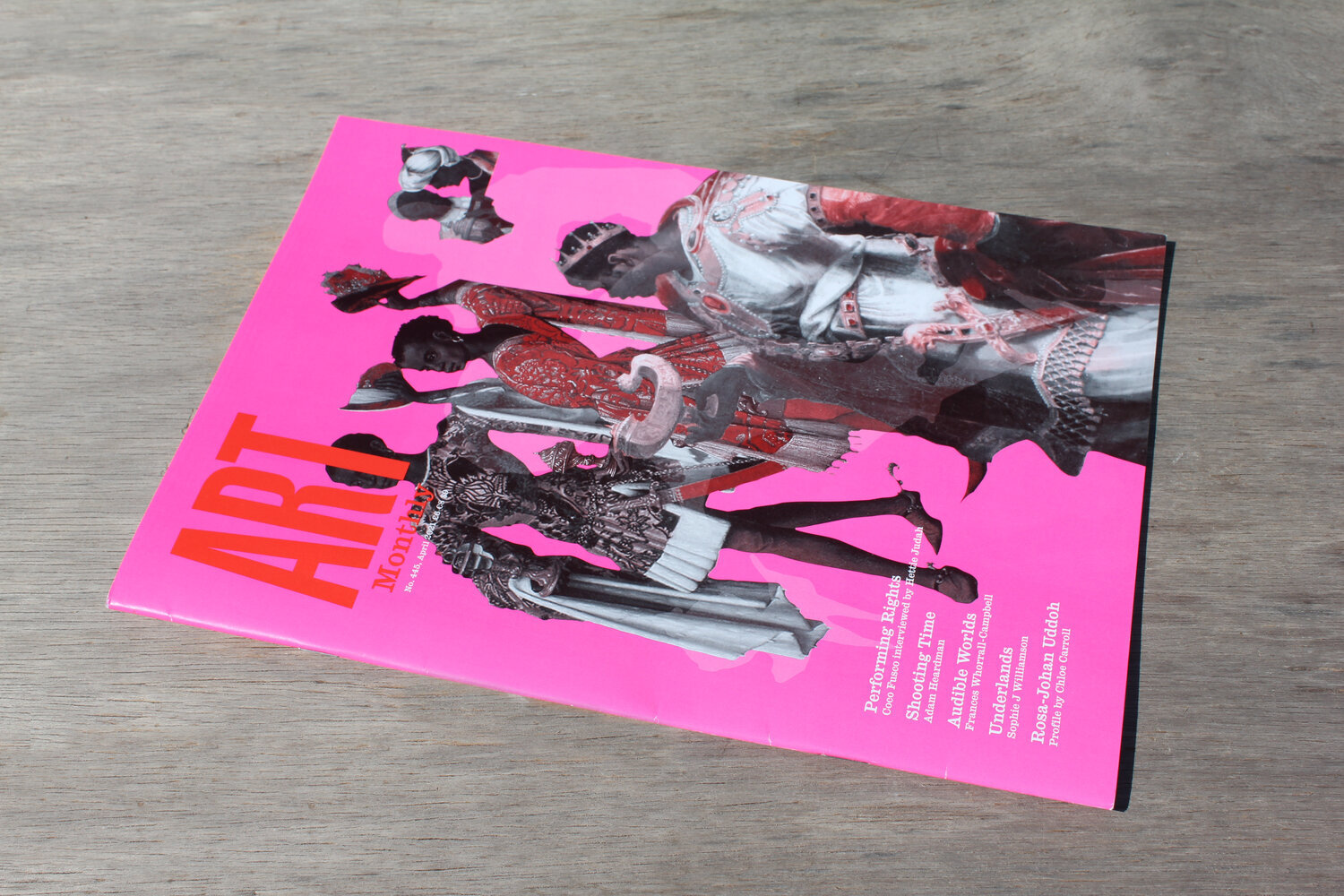
Art Monthly - Chris Clarke review of The Law is a White Dog

"There is a tendency to think of the law as immutable, its legitimacy based on its consistency and equal application across all members of society. This is, to be sure, an idealistic view, whereby laws are agreed to be followed by consensus, by a shared willingness to concede certain of our individual rights to a greater common good. In this scenario, we adhere to the law because it works to the advantage of all; it is imperfect but essentially fair, reliable, equitable. In reality, though, when challenging established precedents, one encounters any number of biases and agendas, omissions and obstacles. The Law is a White Dog, a reader accompanying the 2020 TULCA arts festival in Galway, Ireland, curated by Sarah Browne, addresses such inadequacies as well as the capacity of individuals and movements to effect legislative change." Chris Clarke

Chris Clarke
is a critic and senior curator at The Glucksman, Cork.

Art Monthly 445 is available to order here


The Law is a White Dog

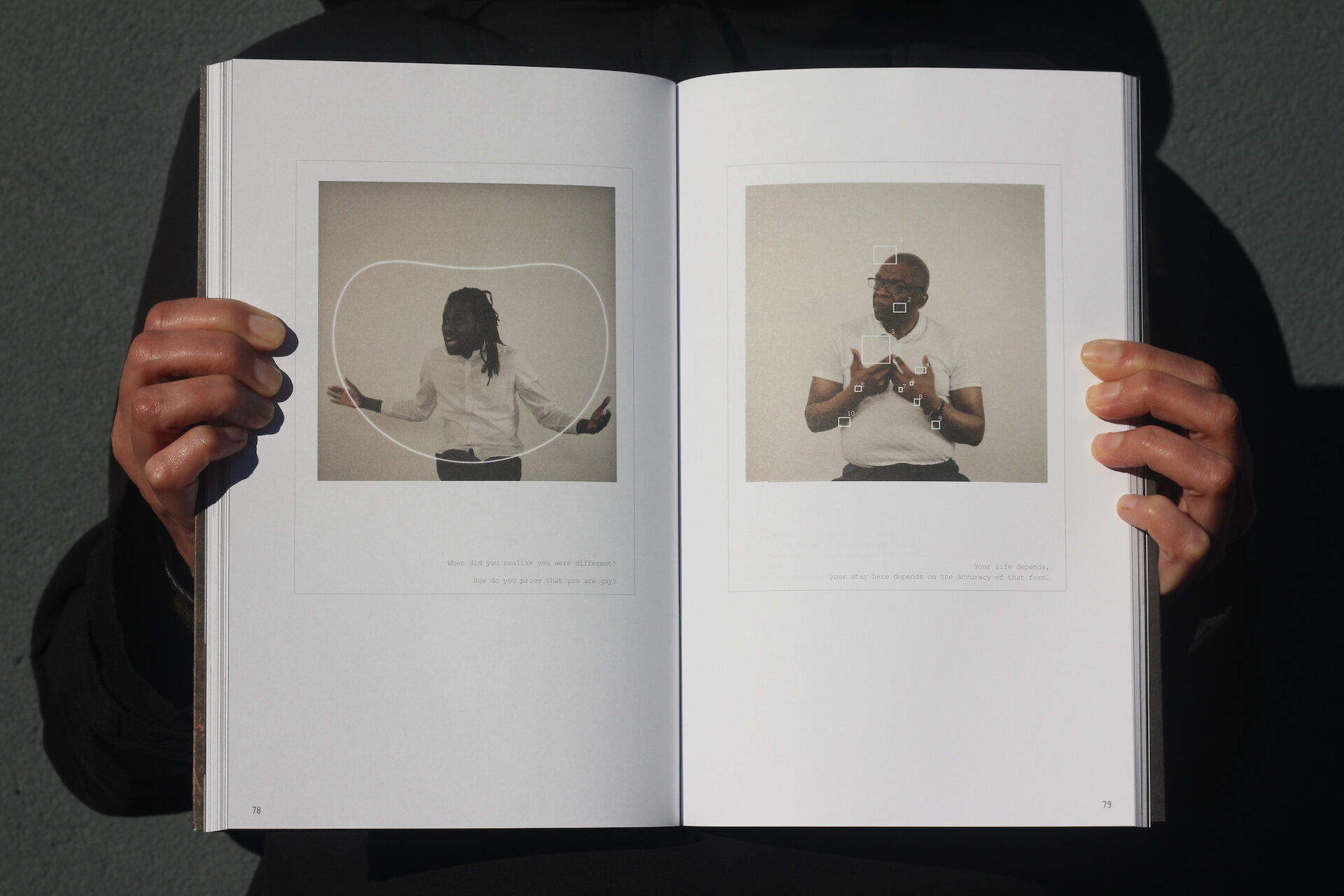
This limited edition book is published on the occasion of TULCA Festival of Visual Arts, 2020, titled The Law is a White Dog. Curated and edited by Sarah Browne, the book features a richly-illustrated introductory essay which frames a wide range of newly commissioned writing, imagery and other original research by artists, poets, activists and lawyers.

Contributions include poetry by Julie Morrissy, photography by Rajinder Singh, and an illustrated essay by Eimear Walshe. The book also presents extracts from two intergenerational projects concerned with feminist activism: artist duo Soft Fiction Projects contribute a selection of censored periodicals from the 1970s they are using to develop a collaborative zine with a group of young people in Galway. Caroline Campbell (Loitering Theatre) presents ‘Protest Archive’, a feminist folklore enquiry made in collaboration with ageing activists. The book closes with new writing by Mairead Enright, a Reader in Feminist Legal Studies at Birmingham Law School whose research extends beyond traditional methods of law reform to consider illegality, protest and experimental legal drafting. Her essay explores how the imagery of dogs roams across testimonies of institutional abuse in Ireland, and how survivors insist on forms of repair, accountability and truth-telling that might one day redeem both the law and the state that underwrites it. Together, this creative and unruly collection speaks of a refusal to be restricted by categorisation, and the necessity (through law or art) to invent new languages and forms of expression in order to develop affinities with others.

Paperback with folded cover, full colour illustrated, 146 pages.

Publisher: TULCA Publishing, Galway
Publication date: 2020
ISBN: 9781838228408
Price: €15.00

Available to order here

In reviews

REVIEW: Hilary Morley | Visual Artists’ News Sheet

January 7, 2020 TULCA Festival of Visual Arts
In reviews

REVIEW: Áine Phillips | Visual Artists' News Sheet

January 9, 2019 TULCA Festival of Visual Arts
T041118-59.jpg
T101118-23.jpg
T041118.jpg
T101118-26.jpg

Aine Phillips reflects on TULCA Festival of Visual Arts 2018, curated by Linda Shevlin.

A person in complete accord with their environment is described as being in a ‘syntonic state’. Curated by Linda Shevlin, this year’s edition of TULCA Festival of Visual Arts in Galway examined this concept. The artists, thinkers and writers assembled by Shevlin offered different perspectives on this theme, generating various possibilities for viewers to attain syntonic experiences through art.

A vibrant example of human and environmental accord was created on the opening night by Aoibheann Greenan with The Life of Riley. Taking the form of a street procession, led by a lone piper, the work involved a number of Galway buskers, who entertained the crowds, alongside the artist and her cast of performers, animating the nighttime city streets and leading the audience from the festival gallery to the club. Greenan’s performance incorporated wildly embellished, hybrid costumes and props that mingled elements of Irish and Mexican visual motifs. Darkly funny, bizarre and congruent with Galway’s street performance culture, the event also presented a contemporary take on histories of the Great Famine period, a subject in Ireland deserving of new modes of analysis and interpretation. Video documentation of the performance was later presented to great effect on the top floor of the Fishery Watchtower Museum, a unique Victorian building that houses a collection of fishery memorabilia and vintage photographs.

TULCA was originally initiated 16 years ago, by Galway artists and curators, to counter the distinct lack of visual art spaces and resources in the city. This deficiency unfortunately persists, with space now at a premium, in the run up to Galway 2020; however, TULCA continues to enliven empty venues with contemporary art each year. Columban Hall, a former Congregational church, was theatrically lit to produce a unifying sense of anticipation and discovery. Helen Hughes commanded the space with her series of collapsed inflatable forms, deluged with paint, like extravagant mollusks or the discarded parts of an alien apparatus. Both Laura Ní Fhlaibhín and Rosie O’Reilly’s installations were complex narrative works involving multiple elements, correlating with each other to give the impression of an uncommon museum.

Another repurposed space, the festival gallery at Fairgreen House, displayed ‘Empathy Lab 2018’, a series of paintings by Colin Martin exploring ambiguous sci-fi subjects betraying modernist futuristic fantasies. Martin’s realism utilises a calm and banal painterly execution, to chilling effect. Robot children and cyberphobic computer banks assert the future is now and it is sufferable. Conor McGarrigle’s #RiseandGrind gave the opposite impression. His ordered algorithmic systems of thought, manifested across interconnected screens, seemed beyond human apprehension and tolerance. Denis McNulty’s video installation, David (Timefeel), featured the music and animated stills of a fresh-faced Bruce Springsteen, trapped in an endless recursive edit.

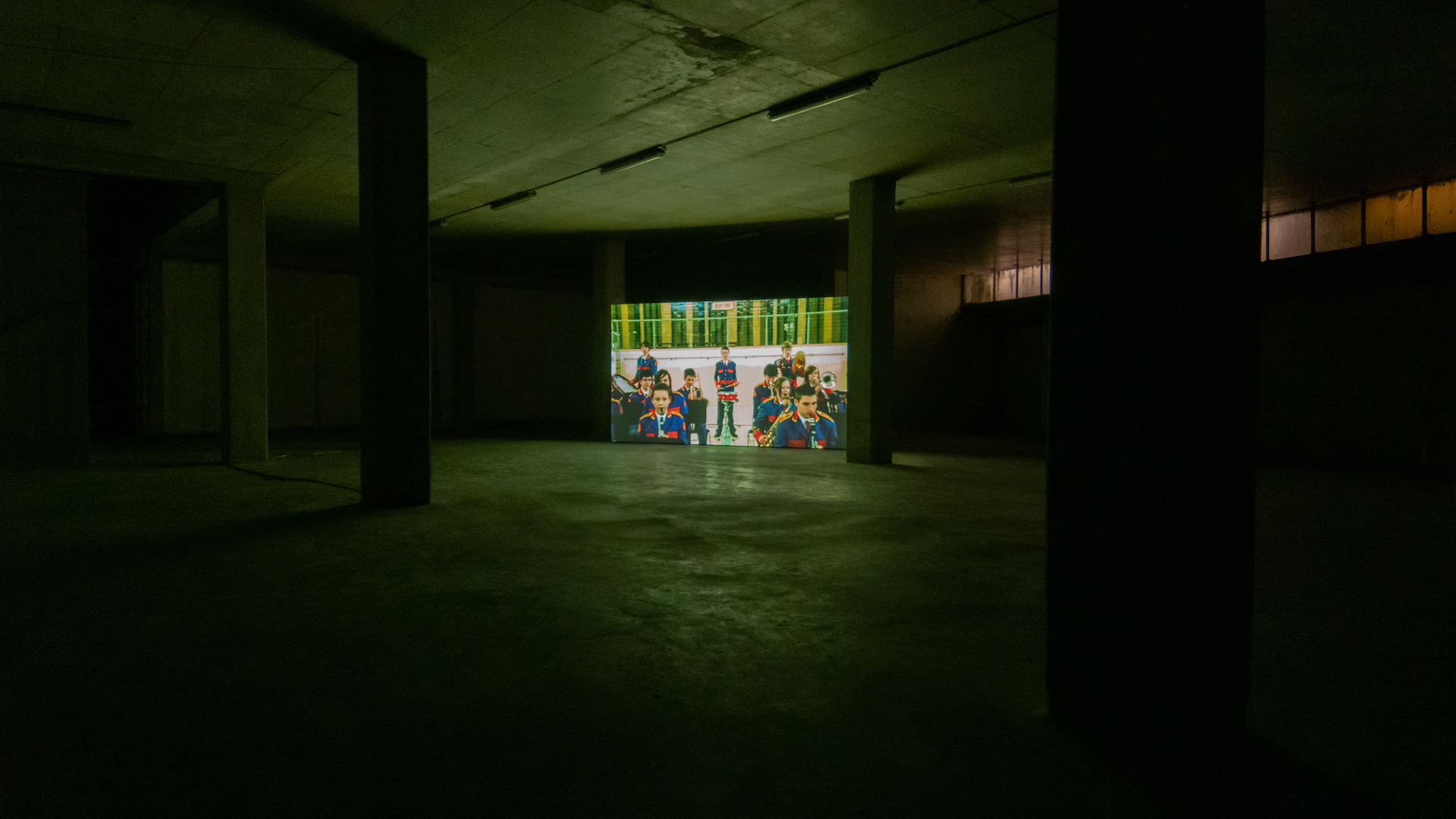
An exquisite contradiction to these restrained works was Stella Rahola Matutes’s Babel, teetering upright pillars of shimmering borosilicate glass. Invigilators hovered nearby to defend the delicate baroque shafts from the vibration of viewer’s footfall. This building has a vast underground concrete edifice, which was occupied by Jesse Jones’s Zarathustra, cinematic documentation of the Artane Band performing in an abandoned Ballymun swimming pool, wistfully redolent of failed housing projects in Dublin’s recent past. The bleak chamber was haunted by the notorious past atrocities and abuses perpetrated on the children of the original Boys Band, part of the Artane industrial school.

As explored in much of the works included in Shevlin’s edition of TULCA, the ‘syntonic’ also evokes sensations of longing for previously experienced states of harmony or oneness with our surroundings. Nostalgia and a yearning for an idealised past or future, was succinctly expressed in Cities of Gold and Mirrors (2009), the work of Cyprien Gaillard installed in 126, Galway’s artist-run gallery. This 16mm film has the aura of seductive lost worlds. A mirrored tower block dissolving in a controlled explosion, and the sun-drenched rutting contests of young men, provided haunting metaphors for evanescent desire.

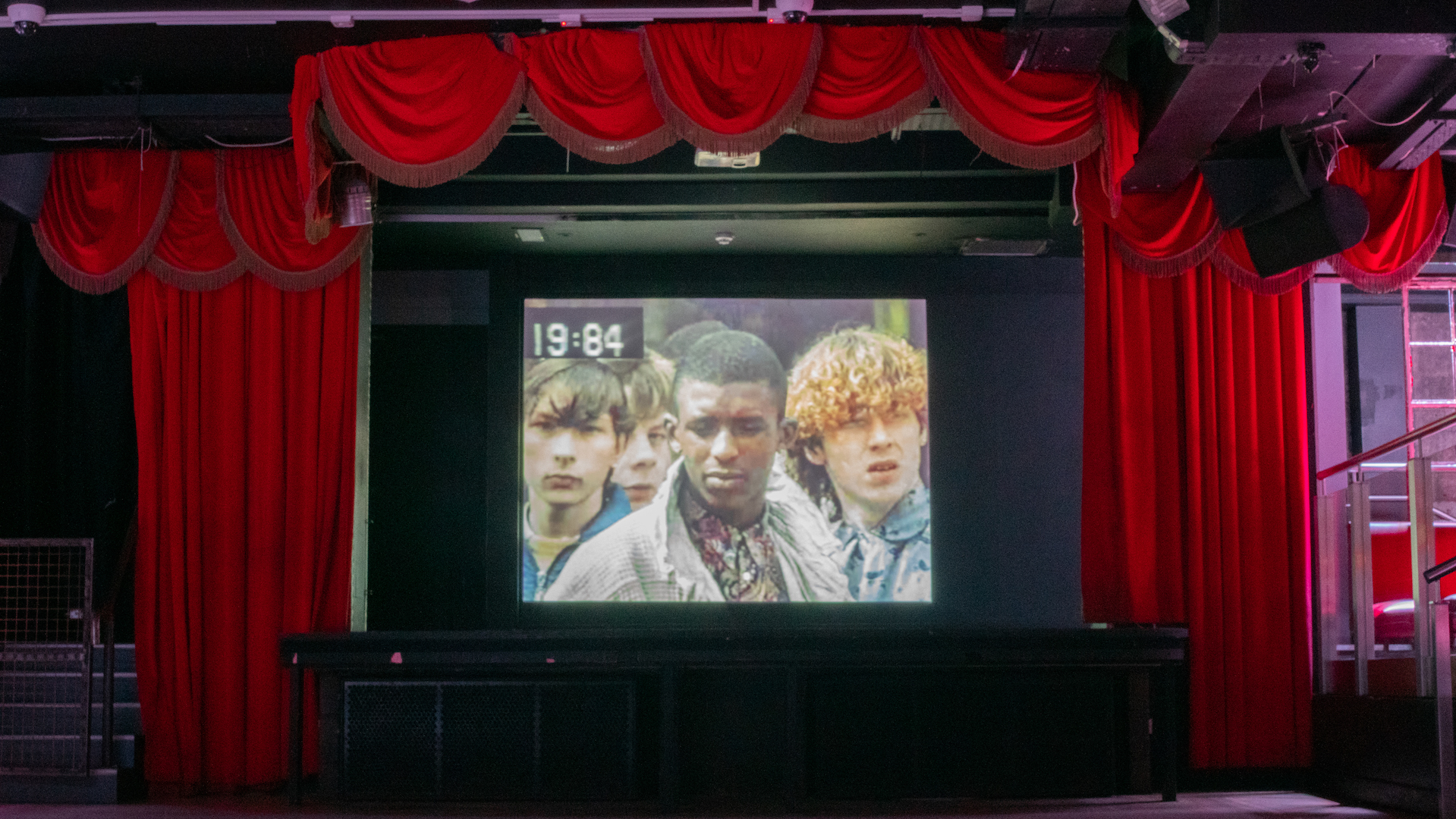
In syntonic accord at the Electric nightclub, Mark Leckey’s 1999 cult film, Fiorucci Made Me Hardcore, used found footage to show the evolution of Britain’s nightlife, from Northern Soul and disco to rave culture. Joanne Laws also developed this theme with her text for the festival’s catalogue, which presented an ethnography of rave culture, rooted in her lived experience. She writes memorably that “when returning to a place where I’ve previously spent a lot of time, I half expect to see ghosts of myself in the street, going about everyday business”.1 These phantoms of place and identity were further elaborated in Bassam Al-Sabah’s newly commissioned CGI film work and sculptural installation, Wandering wandering with the sun on my back(2018), at NUIG Gallery. The film features a shimmering young man, trapped in a series of bizarre architectures located in dystopian, desert-like landscapes. Reminiscent of computer game aesthetics, the film implicates the viewer in the protagonist’s struggle to endure traumatic displacements, amidst transcendent, hallucinogenic transformations.

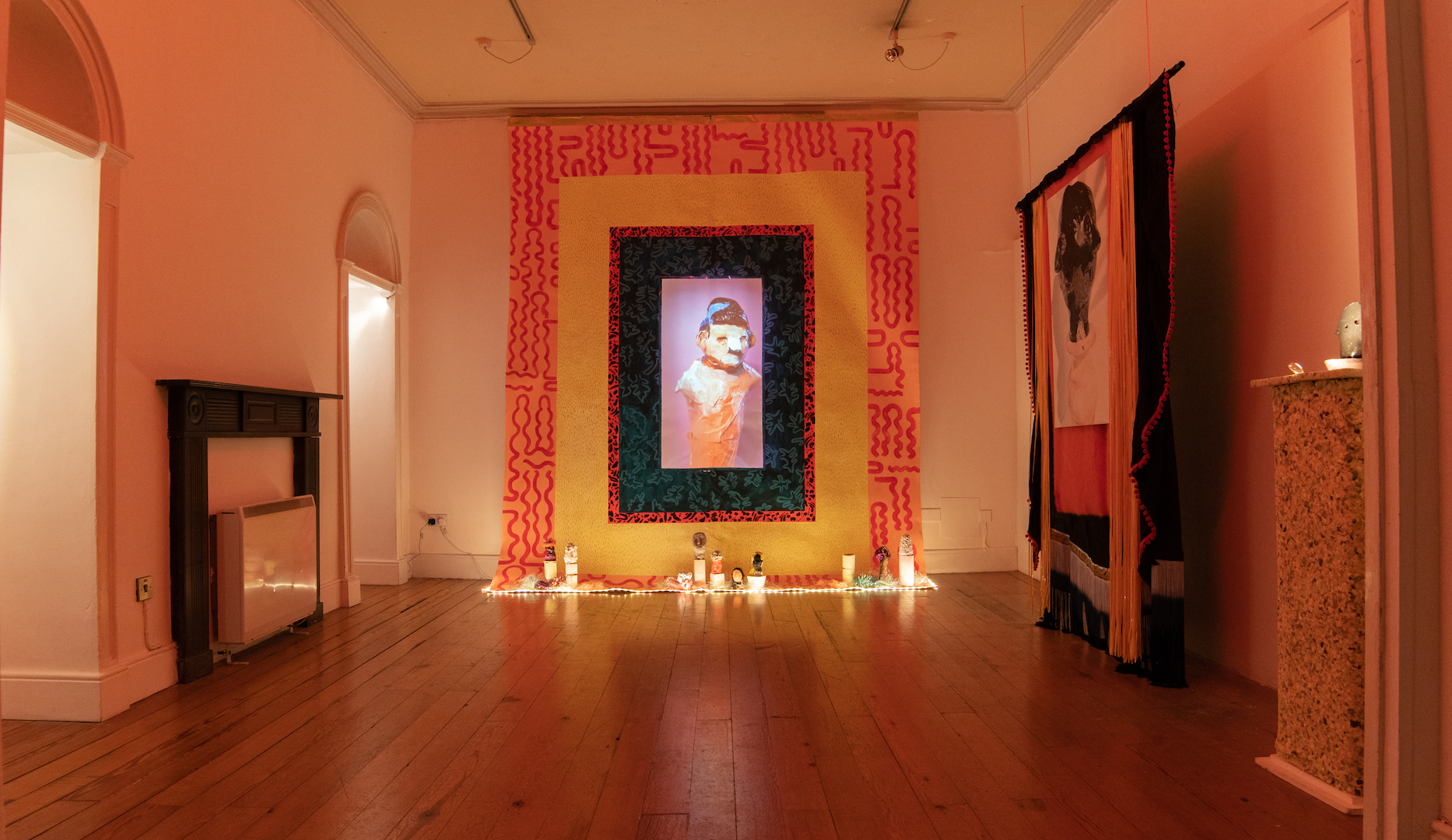
Galway Arts Centre’s ground floor collocated the vibrant neo-fauvist-style paintings and shrine-like banners of Eleanor McCaughey, in her multipart work, The blood-dimmed tide is loosed. In close proximity, Gavin Murphy’s wall installation and narrative video explored the material and cultural histories of the now-defunct Eblana Theatre at Dublin’s Busáras. The work captured fading aspirations of the modern Irish state to locate public memory in our past fantasies of social organisation. Upstairs in the centre, Paul Murnaghan tethered a blackened inflatable island to a heavy weight, under a relentlessly blowing fan, a sad and funny tableau in contrast to Marcel Vidal’s pitch-black colonnades, which incorporated petrified deer hooves and hardware materials, implying a sadistic but satirical violence.

Ciarán Óg Arnold showed the intriguingly titled photographic series, I went to the worst of bars hoping to get killed, channeling Wolfgang Tillmans’s sentiment that “only when you are aware of how tragic life can be, can you also enjoy the depth of a party through the night”.2Other works at the centre were Ciara O’Kelly’s dual-screen video installation, which uses the promotional languages of corporate advertising, with slick humour and elegance. Susanne Wawra’s photo-transfer paintings, based on personal archives from her childhood in East Germany, were suggestive of the dim and aching memory of lost social realities.

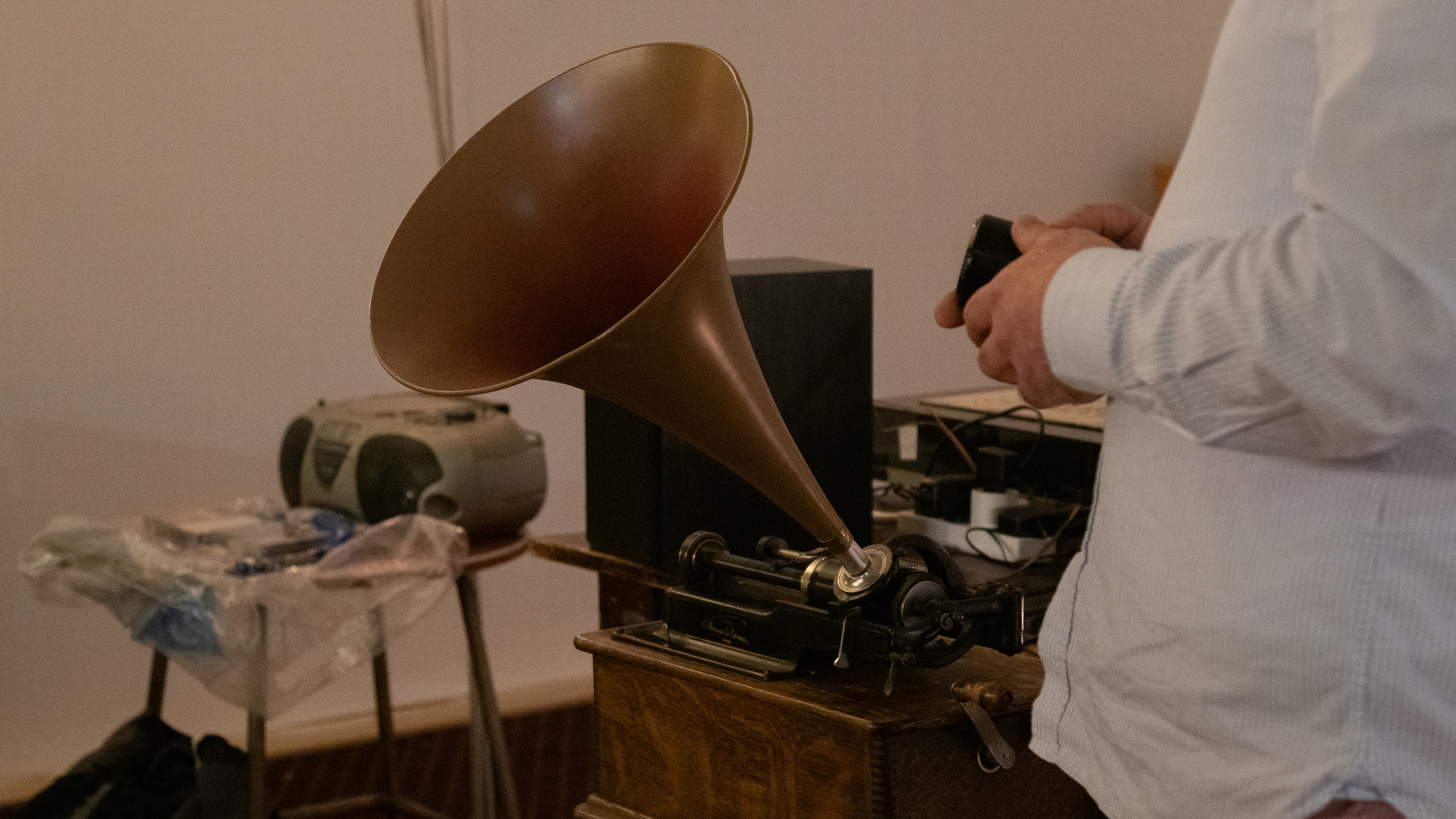
TULCA events this year included a ‘Nostalgic Listening Club’ with Mark Garry, where participants honoured and shared beloved music collections, housed across old and defunct formats, such as cassette tapes, vinyl, gramophone discs and CDs. The Domestic Godless returned to the city soon after a GIAF residency, resuming their crusade to bring flavoursome tastes to celebrate and expand the culturally and historically entangled relationship between society and food. Collaborating with Deirdre O’Mahony in Mind Meitheal, along with EU research centre, CERERE, they presented new imaginings for a ‘heritage cereal renaissance’. Giving material form to this project, Sadhbh Gaston’s emphatic embroidered fabric banners were installed in Sheridan’s on the market. In addition, British writer and journalist Owen Hatherley spoke to Declan Long about his new book, Ministry of Nostalgia, described as a “stimulating polemic” against “austerity nostalgia”. This was followed by a screening of the radical documentary HyperNormalisation by British filmmaker, Adam Curtis, which was introduced by Conn Holohan.

In all, TULCA 2018 provided a rich mix of speculative viewpoints on syntony – a state that seems difficult to attain in modern life, as evidenced by the disconnect we currently manifest, in relation to our ecological and political environments. Clearly, a syntonic state is something to aspire to.

Áine Phillips is an artist based in County Galway.

Notes

  1. Joanne Laws, ‘Feed Your Head: The Speculative Futures of Rave', TULCA 2018 catalogue essay.

  2. Wolfgang Tillmans quoted in Ha Duong, ‘Photographers Who Captured the Ecstasy and Abandon of Rave Culture’, 7 September 2018, artsy.net.

Image Credits 

Mark Leckey, Fiorucci Made Me Hardcore, 1999, video installation, Electric; photograph ©Jonathan Sammon, courtesy TULCA Festival of Visual Arts. 
Jesse Jones, Zarathustra, HD film, installation view, Fairgreen House; photograph ©Jonathan Sammon, courtesy TULCA Festival of Visual Arts. 
Eleanor McCaughey, The blood-dimmed tide is loosed, 2018, installation view, Galway Arts Centre; photograph ©Jonathan Sammon, courtesy TULCA Festival of Visual Arts 
‘Nostalgic Listening Club’ with Mark Garry, 10 November, The Mechanics Institute; photograph ©Jonathan Sammon, courtesy TULCA Festival of Visual Arts

Source: https://visualartistsireland.com/synontic-...
In reviews
← Newer Posts Older Posts →

2019

curator

open call

news

press

opportunties

volunteer

education

about

mission

funding

who we are

archive

TULCA 2025
Curator
Open Call
Gallery Map
Talks
Access

TULCA 2024
Curator
Open Call
Artist Insights
Programme
Gallery Map
Talks

TULCA 2023
Curator
Open Call
Artists
Programme
Gallery Map
Talks

News
Reviews
Talks
Podcasts
Education
Volunteer
Shop

Opportunities
Mailing List
Funding
Board
Team
Mission
Contact

TULCA
Earlswell Court
Cross St Lower
Galway H91 N6WK
Ireland

e: info@tulca.ie

ac-funding-visual-arts-ke-rgb-black.png
GCC logo black landscape.png
gcc-logo.jpg

Mailing List

© 2026 TULCA Festival of Visual Arts | Registered Charity No. CHY20745
Privacy | Governance | Constitution